Practical guide · Trifaar studio
AI Incident Reporting Without Exposing Employee Health Data
How progressive intake, pre-model classification, data minimization, privacy-aware retrieval, human review, and safer logs reduce exposure in AI-assisted EHS reporting.
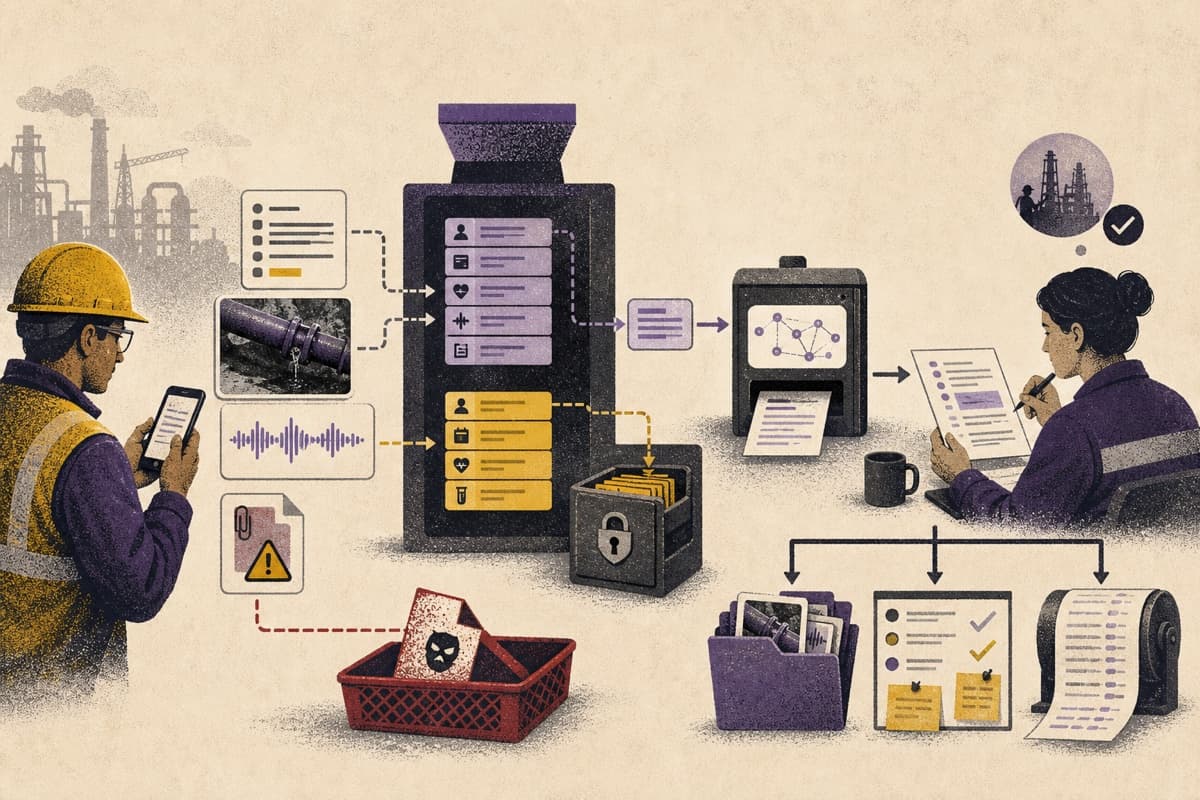
The most dangerous field in an AI-assisted incident form is often the blank text box.
A reporter may enter a diagnosis, medication, phone number, treatment detail, witness name, or story about mental health because it seems relevant. A photograph may capture a badge, medical document, face, vehicle plate, or computer screen. A voice note can disclose even more.
Once the platform sends that material to a model, document parser, transcription vendor, analytics service, or debugging log, a simple incident summary has become a complex data-disclosure workflow.
Here is how to keep AI useful without turning it into a copy machine for sensitive employee information.
First decide whether the data is PHI
Health-related information in an employer’s employment record is generally not PHI under HIPAA. Information held by a covered healthcare provider, health plan, or business associate may be PHI when the legal and operational conditions are met.
The distinction changes the HIPAA analysis, but it should not lower the product’s privacy standard. Injury details can expose an employee to stigma, retaliation, identity theft, or embarrassment even when HIPAA does not apply. State privacy, disability, employment, workers’ compensation, and sector-specific rules may also apply.
Treat HIPAA scope as a legal classification. Treat sensitive employee data as a design fact.
Replace one giant form with progressive disclosure
A better incident intake starts with operational facts:
- what happened;
- when and where it happened;
- task and equipment involved;
- immediate hazards;
- whether urgent care was needed;
- witnesses and evidence;
- actions already taken.
Ask for clinical detail only when a defined workflow and authorized role need it. Explain why a field is requested. Use structured choices where they produce a valid record, but keep an “other” route so the form does not distort reality.
This reduces accidental oversharing before AI is involved.
Detect sensitive content before the model call
Run classification at the application boundary. The control should inspect text, transcripts, images, and attachments before an external AI service receives them.
Possible actions include:
- block a model call and route the record to an authorized reviewer;
- remove direct identifiers that are unnecessary for the task;
- replace a name with a stable case token;
- crop or blur an unrelated badge or face in an image;
- separate a clinical attachment from the operational incident record;
- use a locally controlled model for the first-pass classification;
- select a specifically approved processing route for ePHI.
Automated redaction is fallible. Test it on the language, abbreviations, images, and document formats workers actually submit. Low confidence should trigger human review, not silent passage.
Minimum necessary is a workflow rule
HHS describes the minimum-necessary standard as reasonable steps to limit the use, disclosure, and request of PHI to what is needed for the intended purpose.
In product terms, the application should build a task-specific input. A model classifying event type may need the event narrative and equipment involved. It probably does not need the employee’s full name, home address, insurance details, complete medical note, or unrelated incident history.
The same principle applies to retrieval. Do not let a safety-summary feature search every clinical document because the user has access to one incident. Retrieval permissions should be evaluated for each source document at query time.
De-identification is more than removing a name
A record can remain identifiable through a rare job, small site, exact date, distinctive event, photograph, or combination of facts.
Under the HIPAA Privacy Rule, formal de-identification uses either Expert Determination or Safe Harbor. A homemade list of fields to blank out should not be described as HIPAA de-identification unless it meets the applicable method.
For internal AI tasks that do not require formal de-identification, pseudonymization and field minimization can still reduce exposure. Be honest about what the control achieves: masking a name is risk reduction, not proof that re-identification is impossible.
Keep the model out of the final authority chain
AI is well suited to drafting a neutral summary, identifying missing fields, translating a report for review, grouping similar events, or suggesting relevant procedures.
It should not make unsupported medical conclusions, determine an employee’s fitness for duty, decide OSHA recordability without accountable review, or close a corrective action on its own.
The reviewer needs to see:
- the original authorized source;
- the redacted or minimized input used by AI;
- the generated proposal;
- cited policy or procedure sections;
- warnings about missing or conflicting evidence;
- an explicit approve, edit, or reject action.
Record the human decision and preserve the issued version. If the model is later changed, the historical report should not silently change with it.
Protect OSHA privacy-concern cases in every output
OSHA requires names to be omitted from the OSHA 300 Log for six categories of privacy-concern cases, with a separate confidential list of names and case numbers.
The risk does not end when the name field is hidden. A generated description such as “the only night-shift laboratory supervisor at the North Annex” may identify the employee. Summaries, dashboards, exports, notifications, search results, and AI answers should apply the same privacy rules as the underlying record.
Test indirect identification deliberately. Give reviewers a way to make a description less specific before it is published or shared.
Do not leak through logs and evaluation data
Teams often protect the production database and then copy raw prompts into application logs, tracing tools, support tickets, screenshots, evaluation datasets, and developer laptops.
Build observability that records the event without repeating all of its content. Use case identifiers, policy outcomes, model version, latency, token counts, and error classes. When content capture is necessary for an approved purpose, restrict access, define retention, document the authority, and protect the dataset like the source system.
Synthetic and formally de-identified examples are preferable for routine testing. Production records should not become a convenient model-evaluation corpus by default.
Test the failures that happen in real reporting
An evaluation set should include:
- copied medical notes with names and dates;
- photos containing badges or screens;
- voice transcripts with misspelled identifiers;
- rare events at small sites;
- conflicting witness accounts;
- empty or ambiguous reports;
- instructions embedded in an attachment that try to redirect the model;
- requests to summarize records outside the user’s permitted site;
- a model outage during a serious incident;
- attempts to export a privacy-concern case through a lower-security channel.
Measure sensitive-data detection, redaction misses, unauthorized retrieval, unsupported claims, reviewer edit rates, false reassurance, and safe fallback—not merely how polished the summary sounds.
How Trifaar can help
Trifaar designs AI-assisted incident, audit, corrective-action, and compliance workflows around data minimization and accountable review. Through our VerifyMC platform experience, we can help an organization replace unstructured reporting with a controlled intake, segregate sensitive records, implement policy-aware AI routing, protect OSHA privacy-concern cases, and preserve a useful audit trail.
We can start with one contained workflow: map its data, identify unnecessary exposure, prototype the review experience, evaluate model behavior, and define the vendor and contract boundary before expanding AI across the EHS platform.
Where HIPAA applies, the client’s privacy, security, and legal teams must validate the full deployment. Trifaar’s role is to make those requirements concrete in the product and its engineering—not to replace that governance.