Practical guide · Trifaar studio
How to Architect an AI-Powered, HIPAA-Ready EHS Platform
The product architecture behind separated health data, minimum-necessary AI inputs, business-associate boundaries, evidence-linked review, audit controls, and safe recovery.
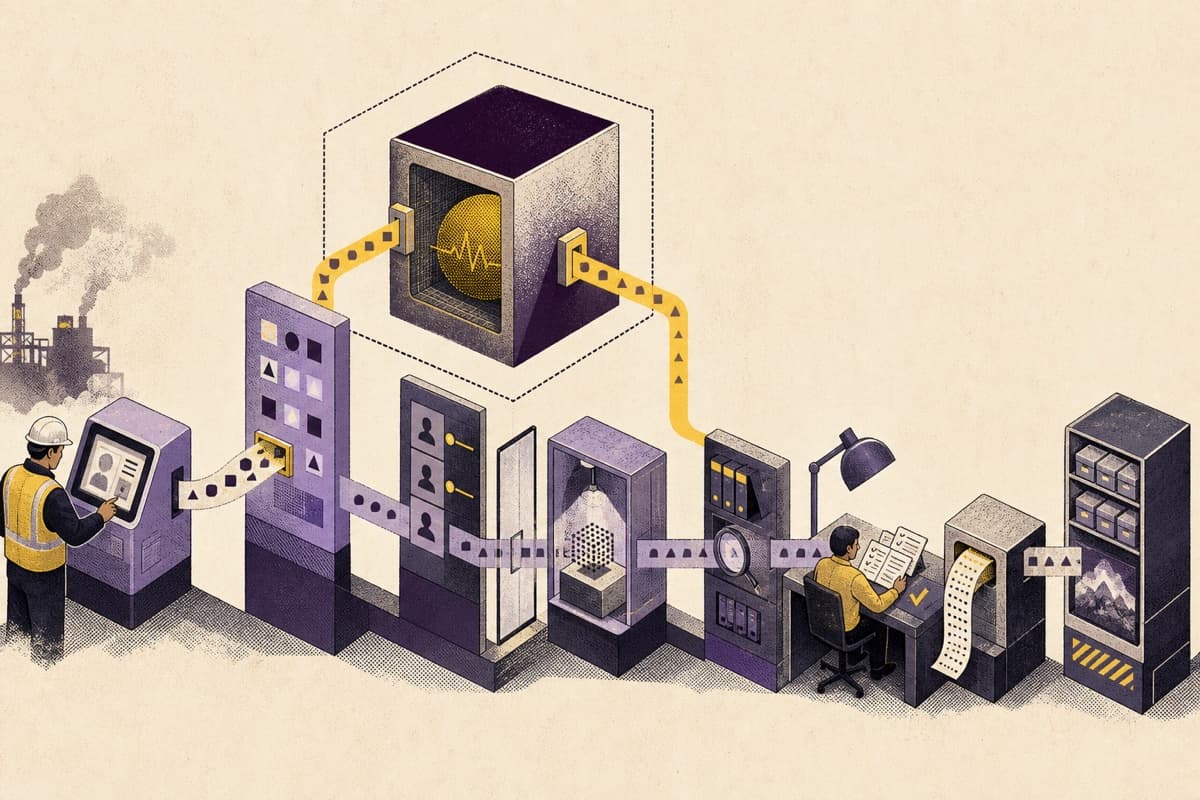
An AI-powered EHS platform can summarize an incident in seconds. The hard part is proving that the model saw only the information it was allowed to see, used it for an authorized purpose, and did not quietly copy it into another system.
That is why HIPAA-ready architecture begins before the model. It starts with data classification, identity, contracts, and operational responsibility.
This article describes a practical architecture for deployments that may handle electronic protected health information (ePHI). It is not a claim that any product is compliant by default; the regulated entity must assess the complete deployment and its use.
Layer 1: separate records by purpose
Do not place every safety, HR, clinical, and health-plan field in one convenient employee profile.
An incident investigation may need the event time, work area, equipment, task, witness statements, injury category, and corrective actions. A clinician may hold a diagnosis, test result, or treatment note. A supervisor usually does not need the clinical record to remove a hazard.
A strong data model separates:
- operational safety records;
- OSHA privacy-concern identifiers;
- occupational health or clinical records;
- group health-plan records;
- attachments and raw media;
- generated summaries and recommendations;
- immutable security and decision events.
The separation should exist in authorization rules and storage boundaries, not only as tabs in the interface.
Layer 2: make identity and purpose enforceable
HIPAA’s Security Rule requires access control, audit controls, integrity protections, authentication, and transmission security for ePHI. In an EHS product, that becomes concrete engineering work:
- unique identities and strong authentication;
- role- and attribute-based authorization at the API and database layers;
- tenant and site isolation;
- purpose-specific views for supervisor, EHS professional, clinician, HR, plan administrator, auditor, and vendor support;
- session controls and privileged-access review;
- encrypted transport and appropriately managed encryption at rest;
- tamper-evident event histories and monitored access logs.
Never rely on a hidden button as an access control. A user who cannot open a clinical record in the interface must also be unable to retrieve it through an API, export, search index, AI tool, or guessed URL.
Layer 3: put a policy gateway in front of AI
The application should not concatenate an entire incident object and send it to a model.
An AI gateway can make four decisions before processing:
- Is AI allowed for this workflow? Some use cases may permit classification but not generative summarization.
- What data class is present? Detect direct identifiers, clinical text, OSHA privacy-concern content, images, and free-text oversharing.
- What is the minimum input? Select only fields necessary for the requested task.
- Which approved route may handle it? Choose the permitted model, region, retention configuration, logging policy, and fallback.
The gateway should fail closed when classification is uncertain. “Send everything and redact later” makes the external disclosure before the control has acted.
Layer 4: treat every AI component as part of the data flow
The model is only one component. A production feature may use speech-to-text, optical character recognition, document parsing, embeddings, vector retrieval, guardrails, evaluation, analytics, and error monitoring.
For every component, record:
- the entity providing it;
- the data it creates, receives, maintains, or transmits;
- storage and processing locations;
- retention and deletion behavior;
- human support access;
- training or product-improvement use;
- encryption and key responsibilities;
- incident-notification duties;
- whether an appropriate BAA or subcontractor agreement is required and available.
HHS states that a cloud provider maintaining ePHI can be a business associate even when the information is encrypted and the provider cannot decrypt it. “No one reads the prompts” is therefore not an adequate vendor assessment.
Layer 5: ground outputs and restrict actions
Generative AI can produce fluent but unsupported conclusions. In an EHS context, a fabricated exposure, incorrect recordability judgment, or invented corrective action can damage the official record.
Use AI for bounded assistance:
- normalize a reporter’s description into a proposed structured record;
- retrieve the relevant approved procedure;
- draft a summary linked to source evidence;
- identify missing fields;
- suggest—not authorize—a corrective action;
- prepare a report for review.
Show reviewers the source fields and policy passages used. Require a named person to approve consequential changes. Keep authorization in deterministic application code. The model should not decide that it is allowed to disclose a record, close a corrective action, notify an external party, or change retention.
NIST’s AI Risk Management Framework emphasizes documented human oversight, privacy-risk assessment, third-party risk, and evaluation across the lifecycle. Those are product requirements, not paperwork to add after launch.
Layer 6: design the audit trail around decisions
An audit event should make it possible to reconstruct what happened without creating an uncontrolled second copy of every sensitive record.
Useful events include:
- user and service identity;
- timestamp, tenant, site, record, and workflow stage;
- data classification and policy decision;
- approved model and configuration version;
- source references or privacy-preserving hashes;
- retrieval sources and document versions;
- proposed output and reviewer disposition where retention is authorized;
- edits, overrides, downstream actions, and export events;
- administrative access and permission changes.
Logs themselves need access control, retention, integrity protection, monitoring, and an incident path. Diagnostic tools must not become an easier way to browse ePHI than the application.
Layer 7: build for availability and correction
The Security Rule protects confidentiality, integrity, and availability. A system that encrypts every field but cannot restore a corrupted incident database is not resilient.
Test backups and restoration. Define recovery objectives. Preserve issued report versions. Allow authorized corrections without erasing history. Provide a manual workflow when the model or vendor is unavailable. Document how data is returned or destroyed when the service ends.
AI features should degrade safely: the incident can still be captured, routed, investigated, and closed when generation is switched off.
A practical release gate
Before enabling AI on a workflow that may involve ePHI, require evidence for:
- confirmed HIPAA role and data-flow map;
- signed contracts and reviewed subprocessors;
- current risk analysis and mitigation owners;
- least-privilege access tests;
- cross-tenant and indirect-object-reference tests;
- prompt, attachment, and retrieval authorization tests;
- unsupported-claim and human-review evaluations;
- logging, monitoring, incident response, backup, and restore tests;
- retention, deletion, export, and service-termination procedures;
- user training and documented operating policies.
Passing a penetration test alone does not satisfy this gate. HIPAA includes administrative, physical, technical, organizational, and documentation obligations.
How Trifaar can help
Trifaar builds EHS and operational software with AI as a controlled workflow component, not an unrestricted chat layer. Our VerifyMC platform work connects incident intake, audits, corrective actions, evidence, reporting, and human approval around one traceable record.
For a deployment involving ePHI, Trifaar can map the data boundary, design isolated stores and access policies, implement an AI gateway, evaluate vendors and subprocessors with the client, create evidence-linked review flows, and build the audit and recovery controls the operating team needs.
The outcome is an architecture designed to support the client’s HIPAA program. Final compliance remains a shared operational and legal responsibility, not a feature a development agency can certify by itself.