Practical guide · Trifaar studio
How We Would Architect an AI Stylist Like WatoWear
The practical product architecture behind useful digital styling: evolving profiles, multimodal garment data, compatibility ranking, expert rules, feedback, and evaluation.
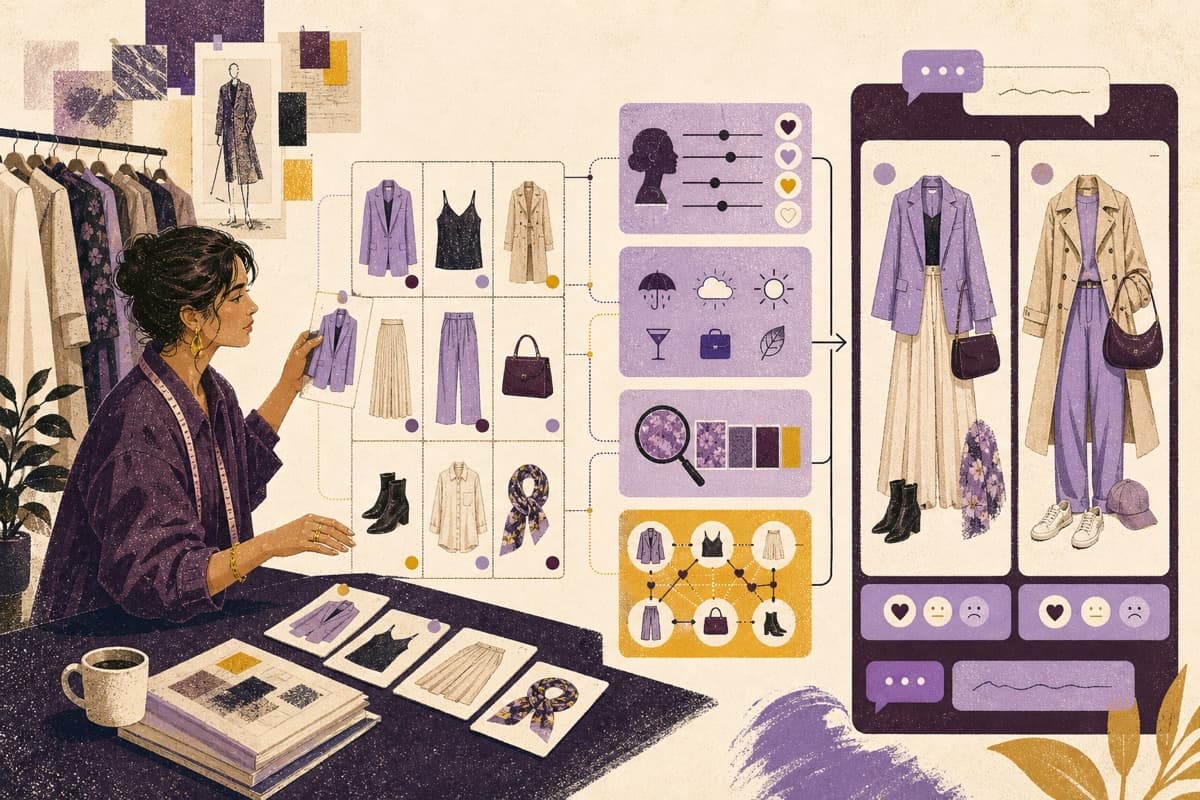
An AI stylist is not a language model with a fashion-themed system prompt.
Styling depends on relationships: the person, the occasion, the weather, the garments available, fit, colour, comfort, budget, and the stylist's point of view. A useful product has to collect enough of that context without turning the experience into an exhausting questionnaire.
That was the product challenge behind WatoWear, the AI stylist brought to Trifaar by Chloe, a stylist from France. Her expertise gave the platform a fashion-led perspective; the engineering work turned that perspective into a repeatable digital journey.
The following architecture describes the practical building blocks for this class of product. It is not a disclosure of confidential client implementation details.
Begin with a style profile that can evolve
A profile should distinguish relatively stable preferences from temporary intent.
Stable signals may include preferred silhouettes, colours, fit, sizing, comfort, modesty requirements, disliked materials, and budget range. Session-level context may include an occasion, location, weather, dress code, garment the user wants to wear, or how experimental they feel today.
Do not ask for everything upfront. Begin with the minimum needed to produce a useful recommendation, then let feedback improve the profile. Store the underlying choices, not only a generated summary that becomes difficult to correct.
Represent garments as more than images
Visual similarity is useful but insufficient. Two garments can look related while serving different seasons, sizes, price ranges, or occasions.
A garment record may combine:
- images and visual embeddings;
- category, colour, material, pattern, and silhouette;
- available sizes and fit notes;
- brand or retailer metadata;
- price and availability;
- season and occasion tags;
- user ownership or wardrobe status.
Multimodal retrieval can use both text and images, while structured filters enforce hard constraints. An elegant result that is unavailable in the user's size is not a good recommendation.
Separate retrieval, compatibility, and explanation
One model call should not be expected to discover candidates, enforce every constraint, rank complete outfits, and explain the styling logic reliably.
A stronger pipeline is:
- Retrieve garments that satisfy availability and context.
- Score candidate combinations for compatibility and user preference.
- Apply stylist-authored rules and exclusions.
- Generate a concise explanation grounded in the selected items.
- Present alternatives and capture feedback.
This separation makes the product easier to evaluate. Retrieval can be tested for relevance, ranking for choice quality, and generation for clarity without hiding every failure inside one paragraph.
Encode the stylist's expertise explicitly
Chloe's value is not reducible to a collection of fashionable sentences. Her expertise includes which questions matter, which combinations work, when a rule should bend, and how advice should be expressed.
Capture that knowledge in product assets the team can inspect: compatibility rules, labelled examples, outfit rubrics, prompt examples, evaluation cases, and interface decisions. A model may execute or extend the pattern, but the platform should retain the domain logic as first-party product knowledge.
Design recommendations for comparison
Users need to decide, not merely read.
Present a complete outfit with clear item relationships, a short reason it suits the context, and one or two meaningful alternatives. Let the user replace an item without restarting. Distinguish “not my style” from “wrong size,” “too expensive,” or “not suitable for the occasion”; those signals should affect the system differently.
Treat feedback carefully
Preference learning can improve recommendations, but sparse feedback is ambiguous. A skipped outfit may reflect taste, price, availability, or timing.
Use explicit signals where possible and let users view or correct important profile assumptions. Avoid turning sensitive body or identity information into an invisible inferred profile. Define retention and deletion rules for uploaded images and wardrobe data, and confirm the model provider's data controls before launch.
Evaluate like a stylist and an operator
Offline evaluation should cover constraint satisfaction, retrieval relevance, outfit compatibility, diversity, unsupported claims, and explanation quality. Human stylist review remains valuable for difficult or subjective cases.
Production measures should include recommendation saves, replacements, feedback reasons, unavailable-item rate, latency, and the cost per completed styling session. A high click rate does not compensate for repeatedly recommending products the user cannot buy or wear.
How Trifaar can help
Trifaar helps fashion and commerce founders translate domain expertise into product strategy, UI/UX, multimodal retrieval, recommendation logic, evaluation, backend systems, and production deployment. WatoWear demonstrates our approach: preserve the founder's point of view while building a structured experience that is more useful than a generic chatbot.
Clients can use Trifaar's flexible credits across UI/UX, software engineering, senior engineering, DevOps, and AI specialists as the product moves from styling discovery to implementation and scale.