Practical guide · Trifaar studio
How to Measure Whether Your AI Product Is Actually Good
Build task-specific AI evaluations using representative cases, domain rubrics, expert review, failure categories, release comparisons, and cost per accepted result.
The demo works on the founder's favorite examples. A new model sounds more polished. The team says quality has improved.
None of those observations tells you whether the product is ready for real users.
An AI evaluation should answer a narrower question: does this version complete the intended task reliably enough, for the people who will use it, at an acceptable cost and risk?
Write the acceptance rule before testing
“A good answer” is not a usable specification. Name the outcome and the ways it can fail.
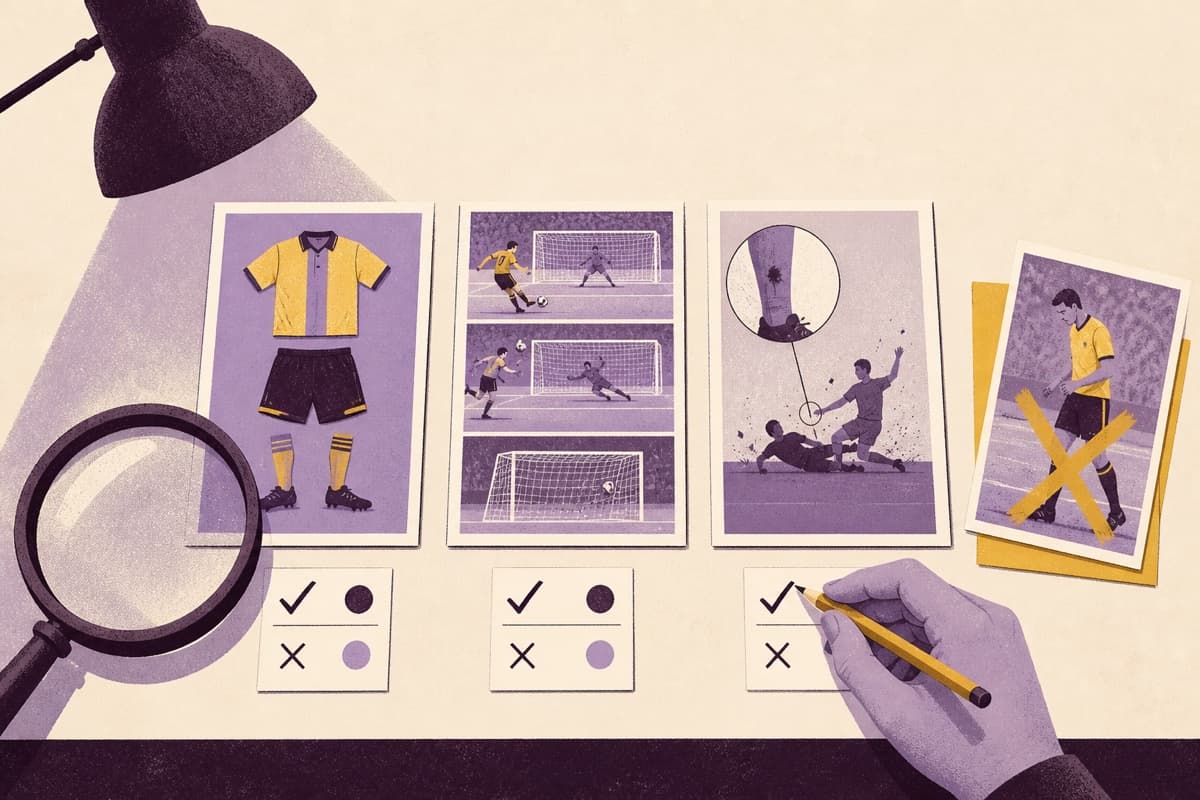
For an outfit recommendation, success might require available garments, appropriate sizing, budget adherence, and a combination the user finds useful. For a sports highlight, it might require the right event and enough footage before and after it. For an incident summary, every material statement may need support in the submitted evidence.
These examples connect to the product categories behind WatoWear, JUU, and VerifyMC. They describe possible evaluation designs, not measured results from those projects.
Build a test set that includes awkward inputs
Start with a manageable set of representative cases and improve it as you discover failures. Include ordinary requests, incomplete inputs, contradictory evidence, edge cases, and requests the system should refuse or escalate.
Keep some cases separate from prompt development. If the team repeatedly adjusts the system against every example, the score can improve while performance on unfamiliar inputs does not.
Version the test data, expected outcomes, source documents, and scoring rubric. Use authorized, minimized data; sensitive production records should not become a casual shared testing folder.
The test set should reflect important user groups and operating conditions. A video detector tested only on clear daytime footage says little about poorly lit local matches. A styling assistant evaluated only on one body type or budget range leaves important product gaps invisible.
Choose measures that reveal the failure
Different jobs need different scorecards:
| Product task | Useful measures | What an average can hide |
|---|---|---|
| Recommend an outfit | Constraint violations, expert assessment, saves, rejection reasons | Attractive but unavailable or unsuitable items |
| Detect match events | Precision, recall, duplicate clips, boundary quality | Many easy detections masking missed goals |
| Summarize an incident | Unsupported statements, omitted facts, reviewer edits | Fluent prose that changes the meaning |
| Answer from documents | Source support, answer relevance, access violations | Correct answers retrieved from unauthorized material |
Precision asks how many proposed detections were correct. Recall asks how many real events were found. A system that proposes one obvious goal and misses the rest can have excellent precision and poor recall. Decide which error is more costly before selecting a threshold.
For generated answers, use explicit rubrics. “Supported by the provided sources” is more actionable than “sounds professional.” Google Cloud's evaluation documentation distinguishes per-example scoring, pairwise comparisons, and aggregate results. Inspect individual failures as well as the summary score.
Do not make the model its own sole examiner
Model-based judging can help scale assessment, particularly for qualities that are hard to capture with exact string matching. It can also reward verbosity, miss domain errors, or favor familiar phrasing.
Calibrate automated scores against human judgments on a reviewed sample. Randomize comparison order where appropriate, hide version labels from reviewers, and investigate disagreements. Use deterministic checks for things that can be checked exactly: required fields, allowed values, valid identifiers, source permissions, or price limits.
A second model's approval is not independent proof that the first model was correct.
Compare one meaningful change at a time
Keep a baseline version and run the candidate on the same cases. Record model, prompt, retrieval configuration, tools, and source versions. Repeat uncertain or variable tests rather than treating a single run as definitive.
Review results by category. If the overall score rises while performance on serious incidents falls, the release may still be unacceptable. Small test sets also produce noisy estimates; avoid advertising a precise reliability percentage from a handful of examples.
NIST's AI Risk Management Framework treats evaluation, privacy, human oversight, and continuing risk monitoring as connected responsibilities. A launch score is a snapshot, not permanent approval.
Watch what happens after release
Offline evaluation cannot show everything. Track task completion, corrections, abandonment, escalations, latency, and cost per accepted outcome. Sample outputs for review with appropriate privacy controls.
Be careful with acceptance rates. A user may accept an answer because checking it is difficult, not because it is right. Pair behavior with expert review and a way to report problems.
Define rollback triggers before a release. A serious authorization failure may justify immediate disablement even when most quality metrics remain healthy. Keep earlier configurations available and make the non-AI fallback usable.
How Trifaar can help
Trifaar's AI development service includes evaluation and safeguards. We can help define task-specific acceptance rules, assemble an authorized test set, compare model and retrieval options, and build a release scorecard that connects technical quality to user outcomes.
Ask Trifaar to evaluate one AI feature. Bring examples of outputs you trust, outputs you reject, and the reasons for both. That conversation is a better starting point than choosing a model from a leaderboard.