Practical guide · Trifaar studio
RAG, Fine-Tuning, or Prompt Engineering: What Does Your AI Product Need?
A founder-friendly decision guide to improving AI instructions, adding current private knowledge, changing model behavior, or connecting controlled business actions.
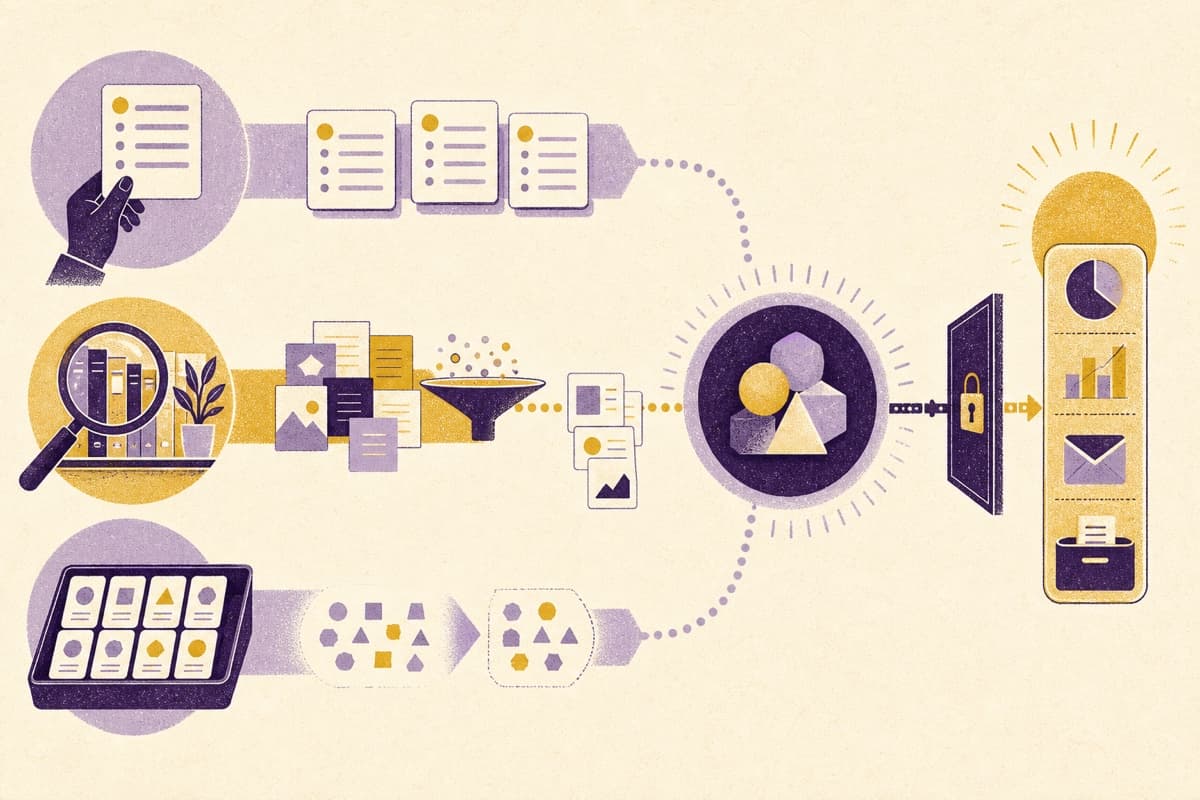
Teams often ask whether an AI product needs retrieval-augmented generation, fine-tuning, or better prompts. The question sounds like a choice between competing technologies. In practice, each one changes a different part of the system.
The least expensive answer is usually the one that matches the actual gap.
Prompt engineering changes the request
Prompt engineering gives an existing model clearer instructions, context, examples, constraints, and an expected output shape.
Use it when the model broadly understands the task but needs consistency. Good candidates include summarization, classification, drafting, extraction, rewriting, and structured responses based on information already present in the request.
Prompting is a sensible first step because it is fast to test and does not create a separate training lifecycle. It still needs an evaluation set. A prompt that works for three hand-picked examples may fail on real variation.
Prompt engineering does not give the model secure access to current private records. Copying an entire database into the prompt is not retrieval; it is an expensive permission and context problem.
RAG changes the knowledge available at request time
Retrieval-augmented generation searches an approved knowledge source, selects relevant material, and supplies that evidence to the model.
Use RAG when answers depend on current, private, or sourceable information: business records, policies, product catalogues, manuals, case files, or other documents that change independently of the model.
Daspire is a clear example. Its product value comes from turning raw business information into searchable, decision-ready insight. That requires ingestion, chunking, metadata, hybrid retrieval, permission filtering, reranking, and source-aware answers. Training a model on a frozen copy of the records would make updates and traceability more difficult.
AWS recommends starting with RAG for question-answering over custom documents and notes that RAG can incorporate recent information and provide source references. The quality of the retriever remains critical: weak evidence produces weak grounding.
Fine-tuning changes model behaviour
Fine-tuning trains a model on examples of desired behaviour. It can help with a stable specialist task, consistent style or formatting, classification performance, or a repeated pattern that prompting alone cannot reliably produce.
It is not a live database. Updating a policy or product price should not require another training run.
Fine-tuning introduces dataset curation, evaluation, training cost, model versioning, and monitoring. It is justified when representative evaluations show that the improvement is worth that lifecycle—not because custom training sounds more defensible in a sales deck.
Tools change what the system can do
Some problems described as “knowledge” are actions.
Checking availability, creating a booking, issuing a refund, or updating a customer record requires a controlled tool or API. The model can decide what information is missing and prepare parameters, but the downstream system must enforce permissions and validate the request.
OWASP calls out excessive agency as a risk when an AI system has more functionality, permissions, or autonomy than the task requires. Give tools the narrowest capability possible and use human approval for consequential actions.
A practical decision table
| Need | Start with |
|---|---|
| Clearer instructions or structured output | Prompt engineering |
| Answers from current private documents | RAG |
| Reliable specialist behaviour across many examples | Evaluate fine-tuning |
| Live business action | Validated tool/API call |
| Multi-stage process with approvals | Explicit workflow orchestration |
These approaches can be combined. A RAG system still needs prompts. A fine-tuned model can still use retrieval. An agent can use both, then call a narrowly scoped tool.
Test the smallest sufficient system
Create representative cases and define what acceptable means: factual support, correct structure, retrieval relevance, permission compliance, latency, and cost. Begin with the simplest approach and add complexity only when a measured gap remains.
AWS guidance similarly recommends progressing from prompt engineering to RAG and then customization when required. This avoids paying to operate a training or agent architecture before the product has demonstrated the need.
How Trifaar can help
Trifaar provides GenAI discovery, architecture, prototyping, evaluation, RAG engineering, agent workflows, and production deployment. We help clients choose the smallest architecture that meets the business requirement, then leave clean boundaries so models and providers can change without rewriting the product.
For teams with an existing prototype, Trifaar can benchmark the current approach against prompt-only, retrieval, fine-tuned, and tool-assisted alternatives using the same representative test set.