Practical guide · Trifaar studio
From Spreadsheet to Internal Platform: When Is Custom Software Worth It?
Evaluate spreadsheet improvements, existing software, integrations, and custom platforms using real workflow friction, baseline costs, migration, and adoption.
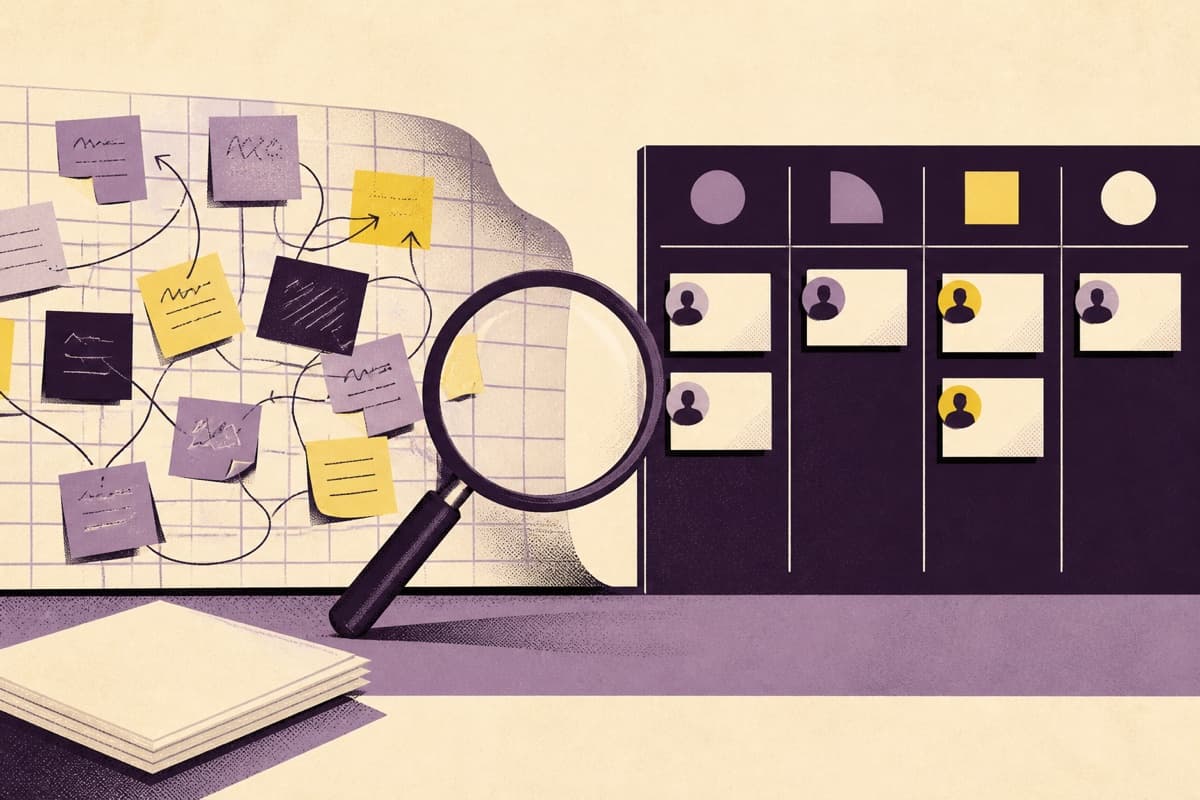
A spreadsheet is not a failed application. It is often the fastest way to understand a process that is still changing.
The problem starts when the sheet quietly becomes a multi-user operating system: one person controls approvals, another copies rows into accounting software, and everyone keeps a private version because the shared one cannot be trusted.
That is the moment to investigate—not automatically the moment to commission custom software.
Look for coordination failures, not large row counts
A large spreadsheet can be perfectly useful. A small one can create serious operational risk.
Observe how work moves through the business. Are requests lost between teams? Does someone repeatedly ask who approved a change? Are customers receiving inconsistent updates? Do employees spend time reconciling copies rather than completing the work?
The important signals are unclear ownership, repeated re-entry, access problems, fragile calculations, missing history, and exceptions that depend on one experienced employee. A custom interface will not resolve those issues unless the underlying process is understood.
Watch a real request travel through the process
Pick a recent order, application, service request, or compliance task. Follow it from arrival to closure. Include email, messaging, phone calls, paper, and systems outside the spreadsheet.
Record the states, people, decisions, waiting periods, and rework. Ask what happens when information is missing or a decision is reversed. The unofficial process is often more informative than the written procedure.
The GOV.UK discovery guidance emphasizes understanding the problem and constraints before building, including the possibility that stopping is the right outcome. Although written for public services, that principle is useful for an internal business tool too.
Compare four options honestly
| Option | A reasonable fit | A warning sign |
|---|---|---|
| Improve the spreadsheet | Stable, limited workflow with manageable access needs | People need record-level permissions or reliable concurrent actions |
| Configure existing software | A standard process already covered by a suitable product | Extensive workarounds recreate the old manual process |
| Add integrations or a small portal | The main system works but one handoff is painful | The added layer becomes another conflicting source of truth |
| Build a custom platform | A valuable, distinctive workflow with clear ownership | Requirements remain unclear or nobody will maintain the system |
Do not compare a custom platform with the worst possible spreadsheet. Compare it with a cleaned-up process and the best realistic off-the-shelf alternative.
Estimate the benefit without inventing savings
Measure the current process before forecasting improvement. Useful baselines include handling time, completion time, rework, overdue items, support requests, and cost per completed case.
GOV.UK's performance guidance connects service measurement to completion, satisfaction, adoption, and cost per transaction. A business can adapt those categories without adopting every public-sector reporting obligation.
Suppose, purely as an illustration, 240 monthly requests each involve ten minutes of duplicate entry. That is 40 hours of work. Removing half would release 20 hours, but it would not automatically cut payroll by that amount. The benefit might be faster response, fewer overtime hours, or capacity for additional work.
Compare that benefit against development, configuration, migration, licenses, hosting, training, support, and maintenance. Include the effort of running old and new processes during transition. If the value depends on unrealistic adoption or perfect automation, narrow the project.
Model records and decisions before screens
A useful internal platform makes the current state and next responsibility explicit. Start with the main record, its identifier, allowed transitions, required evidence, owner, due dates, and permissions.
For example, a service request might move from submitted to triaged, assigned, in progress, awaiting customer, and closed. Decide who can move it, which fields are required, and how it reopens. A status dropdown without those rules can reproduce the spreadsheet's ambiguity in a more expensive interface.
Keep an event history for significant changes. Automations should be retry-safe and observable. If an integration fails, staff need to know which records are affected and how to recover them.
Migrate one bounded workflow
Choose a pilot with enough volume to learn from but limited consequences if something goes wrong. Clean identifiers and duplicates, map fields, preserve required history, and reconcile imported records with the source.
Decide which system accepts new updates during the transition. Indefinite dual entry creates conflicting data and makes adoption harder. Provide a cutover plan, rollback conditions, and a named business owner.
Test with the people doing the work, including someone unfamiliar with the proposed interface. Their ability to find a record, understand its status, and handle an exception matters more than the number of features delivered.
Add AI only where the process benefits
AI may help classify an incoming request, extract fields from documents, or draft a response. It is not necessary for assignment rules, due-date reminders, arithmetic, or clear approval routing.
Keep extracted values reviewable and connect them to source evidence. Do not let a generated answer become the only record of a business decision. Start with deterministic automation where the rules are known and reserve AI for genuinely ambiguous input.
How Trifaar can help
Trifaar's custom CRM and workflow automation service starts with the operating process: who does what, where work waits, and which data should be authoritative. We can help evaluate configuration versus custom development, prototype one workflow, and plan migration and adoption.
Trifaar's work across operational products such as VerifyMC provides relevant project context; any forecast savings for your organization should come from your own baseline and pilot results.
Bring Trifaar the spreadsheet and one recent case. We can help determine whether you need a better sheet, an integration, or a focused internal platform—and define what improvement would actually count as success.