Practical guide · Trifaar studio
The Vibe-Coded MVP Rescue Guide: Keep, Refactor, or Rebuild?
How to audit an AI-built MVP, preserve validated product work, repair change-resistant code, and rebuild only the boundaries that cannot be trusted.
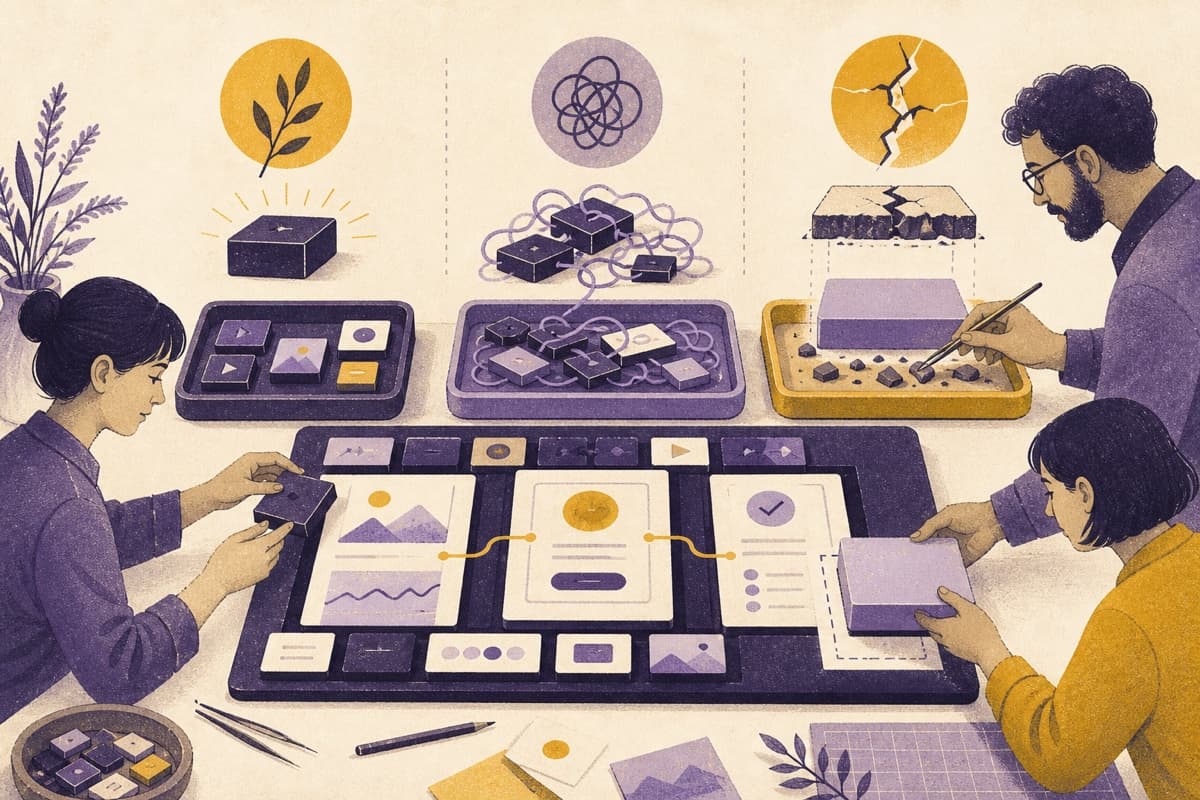
The first question about a struggling vibe-coded MVP should not be, “Do we have to rebuild it?”
It should be, “What have we already learned and which parts are still trustworthy?”
A prototype may contain a valuable workflow, real customer evidence, a useful interface, and weeks of product thinking even when its technical foundation is fragile. Replacing everything throws away that knowledge. Keeping everything can turn every future feature into a negotiation with accidental complexity.
A rescue audit separates those two decisions.
Begin with four kinds of evidence
Before reading every file, collect:
- Product evidence: Which journeys have users completed? What do they value?
- Operational evidence: What breaks, slows down, or requires manual repair?
- Security evidence: What data, permissions, integrations, and credentials are exposed?
- Code evidence: Which areas change predictably, and which changes create unrelated failures?
The application should be judged against its intended use. A private prototype with fictional data has a different risk profile from a multi-tenant product accepting payments.
Keep what expresses validated product knowledge
Useful work often survives even when the implementation needs attention:
- tested user journeys;
- content and information architecture;
- a clear domain vocabulary;
- reusable visual components;
- customer feedback and analytics;
- API contracts that accurately represent the business;
- small, well-tested modules with limited responsibilities.
Preserving these assets saves more than development time. It keeps the product from forgetting what users already taught the team.
Refactor code that works but resists change
Refactoring is appropriate when behaviour is broadly correct but the implementation is difficult to extend or verify.
Common candidates include repeated business logic, oversized interface components, direct database calls scattered across the application, inconsistent validation, weak error handling, and configuration mixed into code.
The safest sequence is to add tests around current behaviour, isolate one responsibility, improve it, and verify again. A large “clean-up” pull request generated in one pass recreates the original problem: too much change for a reviewer to reason about.
Rebuild boundaries that cannot be trusted
Some foundations should not be patched indefinitely.
Examples include authorization enforced only in the browser, tenant records stored without a reliable ownership boundary, payment flows that cannot reconcile retries, production secrets committed to the repository, or destructive operations with no audit history or recovery path.
Rebuilding a boundary does not require rebuilding every screen. A new service layer, database schema, or authentication model can often be introduced behind validated parts of the product.
Use a risk-based decision matrix
Score each area on four questions:
| Question | Low concern | High concern |
|---|---|---|
| User value | Rarely used | Core validated journey |
| Failure impact | Cosmetic inconvenience | Money, privacy, safety, or lost data |
| Changeability | Small changes stay local | Small changes cause regressions |
| Testability | Behaviour can be verified | Behaviour is implicit or unobservable |
High-value, low-risk components are strong keep candidates. High-value components with poor changeability usually deserve controlled refactoring. High-impact boundaries that cannot be tested are rebuild candidates.
Stabilize before adding the next major feature
Founders often request an audit because a new feature has become difficult. Adding it immediately may bury the evidence.
A short stabilization phase should:
- rotate exposed credentials;
- close obvious permission gaps;
- establish a repeatable build and deployment;
- add logs and error reporting;
- capture critical-path tests;
- back up production data;
- document the system boundary and known risks.
This creates a safe platform for the next decision, even if a larger migration follows.
Do not let generated code expand the review bottleneck
DORA describes AI as an amplifier of the delivery system around it. If the team has clear architecture, tests, review, and small batches, AI can increase useful throughput. If those controls are weak, it can produce more code than the team can responsibly verify.
During a rescue, constrain assistants to narrow changes with explicit acceptance criteria. Review diffs, run tests, scan dependencies, and keep database migrations reversible. GitHub's guidance similarly places responsibility on developers to test AI-generated changes for correctness and security.
What a good rescue plan contains
The final plan should not be a vague list of “technical debt.” It should identify:
- immediate security and data risks;
- modules to keep unchanged;
- refactors tied to upcoming product work;
- boundaries that require replacement;
- migration and rollback steps;
- expected user impact;
- the team mix and sequence required.
Each item needs a reason. “Not how we would build it” is not enough.
How Trifaar rescues MVPs
Trifaar audits AI-generated and conventional codebases across product, architecture, security, data, UX, and delivery operations. We translate the findings into a staged plan that protects validated work while repairing the foundations that would otherwise increase cost.
Clients can then use Trifaar credits across UI/UX, software engineers, senior engineers, DevOps, and AI specialists. That makes it possible to use senior attention for architecture and risk, then shift implementation to the appropriate resource level instead of carrying one expensive team shape throughout the rescue.