Practical guide · Trifaar studio
When Does an EHS Platform Actually Need to Be HIPAA Compliant?
A practical guide to the boundary between employer safety records, OSHA privacy, PHI, occupational health, health plans, business associates, and AI data flows.
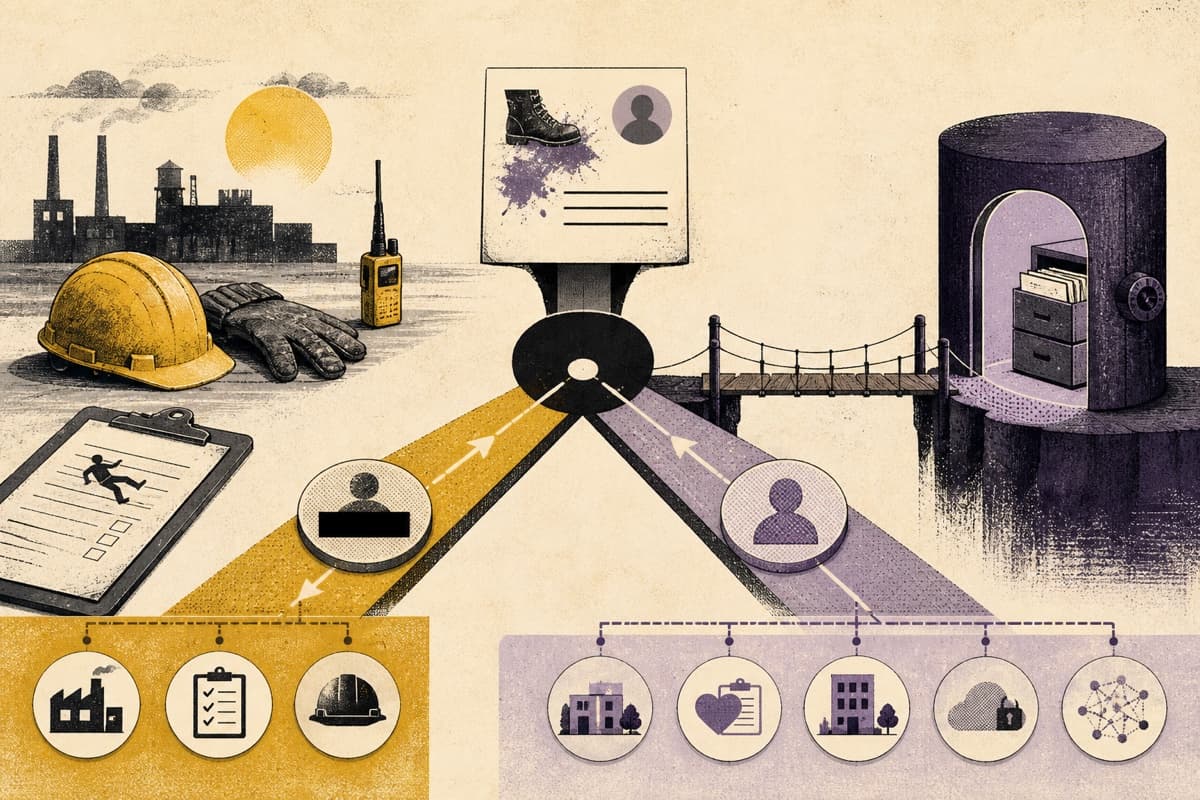
The phrase “HIPAA-compliant EHS platform” sounds reassuring. It is also incomplete.
HIPAA does not apply to a product merely because an incident report contains an injury, a diagnosis, or a doctor’s note. The first question is not whether the software stores health-related information. It is who holds the information, why they hold it, and whether they are acting as a HIPAA covered entity or business associate.
That distinction matters. It determines which records are protected health information (PHI), which vendors need business associate agreements, and where an AI feature may process data.
The uncomfortable truth: most employer records are not PHI
The US Department of Health and Human Services says the HIPAA Privacy Rule generally does not protect employment records, even when those records contain health information. An employer’s injury report, return-to-work document, accommodation record, or workers’ compensation file may be sensitive and regulated by other laws, but it is not automatically PHI under HIPAA.
The same company can hold similar information in two different legal roles:
- as an employer maintaining an employment record; and
- as the sponsor or administrator of a group health plan holding plan information.
The first record may fall outside HIPAA. The second may be PHI. A healthcare organization has the same split: its employee file is not converted into PHI simply because the employer is also a hospital.
This is why a feature checklist cannot determine HIPAA scope. The data flow can.
Where an EHS workflow can cross into HIPAA
An EHS platform may enter HIPAA territory when it handles information for a covered healthcare provider, health plan, or their business associate. Common examples include:
- An occupational health clinic sends results into the platform. A covered provider may disclose limited information for workplace medical surveillance or a work-related injury in specific circumstances, but the disclosure and the receiving workflow need to be mapped carefully.
- The platform serves a group health plan. Individually identifiable information held for plan administration can be PHI even when the employer also uses the product for safety operations.
- A third-party clinical service is embedded. Telehealth, laboratory, vaccination, or medical-review functions may create a covered-provider or business-associate relationship.
- The vendor stores or processes ePHI for a regulated customer. HHS says a cloud service provider that maintains ePHI on behalf of a covered entity or business associate is itself a business associate—even when the data is encrypted and the provider does not hold the decryption key.
If the EHS vendor creates, receives, maintains, or transmits PHI on behalf of a regulated entity, a compliant business associate agreement (BAA) is normally part of the relationship. A BAA is not a decorative legal page. It defines permitted uses, safeguards, incident duties, subcontractor obligations, access, return, and destruction of data.
OSHA privacy is a separate requirement
“Not PHI” does not mean “safe to expose.”
OSHA recordkeeping rules contain their own privacy protections. Under 29 CFR 1904.29, certain cases must be recorded without the employee’s name on the OSHA 300 Log. These include injuries to intimate body parts, sexual assault, mental illness, certain infectious diseases, contaminated needlesticks, and some illness cases where the employee voluntarily requests privacy.
The platform should identify these privacy-concern cases, place the name and case number on a separate confidential list, and prevent a public or broadly shared log from revealing the person indirectly through an overly specific job title, location, or description.
That is a concrete EHS product requirement. It exists whether or not HIPAA applies.
Use a data-flow test, not a logo test
Before selecting or building a platform, draw the actual flow for each record:
| Question | What it reveals |
|---|---|
| Who collected the information? | Employer, clinic, health plan, or another party |
| In what role was it collected? | Employment, treatment, payment, plan administration, or safety compliance |
| Where does it move? | EHS database, clinical system, insurer, AI provider, analytics warehouse, or email |
| Who can see it? | Safety manager, supervisor, clinician, HR, plan administrator, vendor support, or model provider |
| What is the permitted purpose? | Investigation, OSHA reporting, treatment, benefit administration, analytics, or training |
| Which vendors touch it? | Hosting, logging, backups, transcription, document processing, and AI services |
Two systems can both advertise encryption and role-based access while having completely different obligations because their data flows differ.
What “HIPAA-ready” should mean in a product conversation
A responsible vendor should be able to discuss more than encryption. Ask about:
- whether it will sign a BAA when it acts as a business associate;
- which subprocessors may receive ePHI and whether the necessary agreements are in place;
- access controls, authentication, audit controls, integrity, and transmission security;
- risk analysis and risk-management practices;
- backup, availability, incident response, breach support, data return, and deletion;
- minimum-necessary access and separation between employment, safety, and health-plan functions;
- where prompts, model outputs, files, and diagnostic logs are retained;
- whether customer data is used to train a model, and under what authority;
- how the customer can obtain, amend, export, and account for applicable records.
There is no universal government certificate that turns a platform into a compliant deployment. Compliance depends on the regulated organization, the vendor, contracts, configured controls, documented procedures, workforce behavior, and the specific use of data.
AI makes the boundary easier to cross accidentally
A conventional EHS application may send incident text only to its own database. An AI-assisted version might also send it to a transcription service, document parser, model API, vector store, evaluation platform, and observability system.
Each hop can create a new disclosure, retention location, or subcontractor relationship. Free-text reports and photos are particularly risky because they often contain more identifying detail than the workflow needs.
The safer starting point is to classify the record before any model call. Route only the minimum necessary fields. Keep high-risk clinical content in a separated store. Use a provider and deployment configuration appropriate to the data. Log who initiated the AI action and what record it affected, while avoiding unnecessary duplication of sensitive content inside telemetry.
How Trifaar can help
Trifaar designs and builds AI-assisted EHS and compliance products, including the VerifyMC platform work. Our starting point is a data-flow and role-mapping workshop: what is collected, who owns it, which systems receive it, and where human approval is required.
From there, Trifaar can design separated safety and health-data workflows, least-privilege access, privacy-concern case handling, audit trails, controlled AI gateways, corrective-action lifecycles, and vendor boundaries that support the client’s legal and security program.
That work can make a platform HIPAA-ready for an intended deployment. The covered entity or business associate must still validate the final configuration, contracts, policies, and operating practices with its legal, privacy, and security advisers.