Practical guide · Trifaar studio
Why SaaS Clones Fail: Build Around the Market Gap, Not the Competitor
Lessons from Smart360 on using an incumbent as market evidence while building an original workflow, data model, migration path, and operating system for the customer.
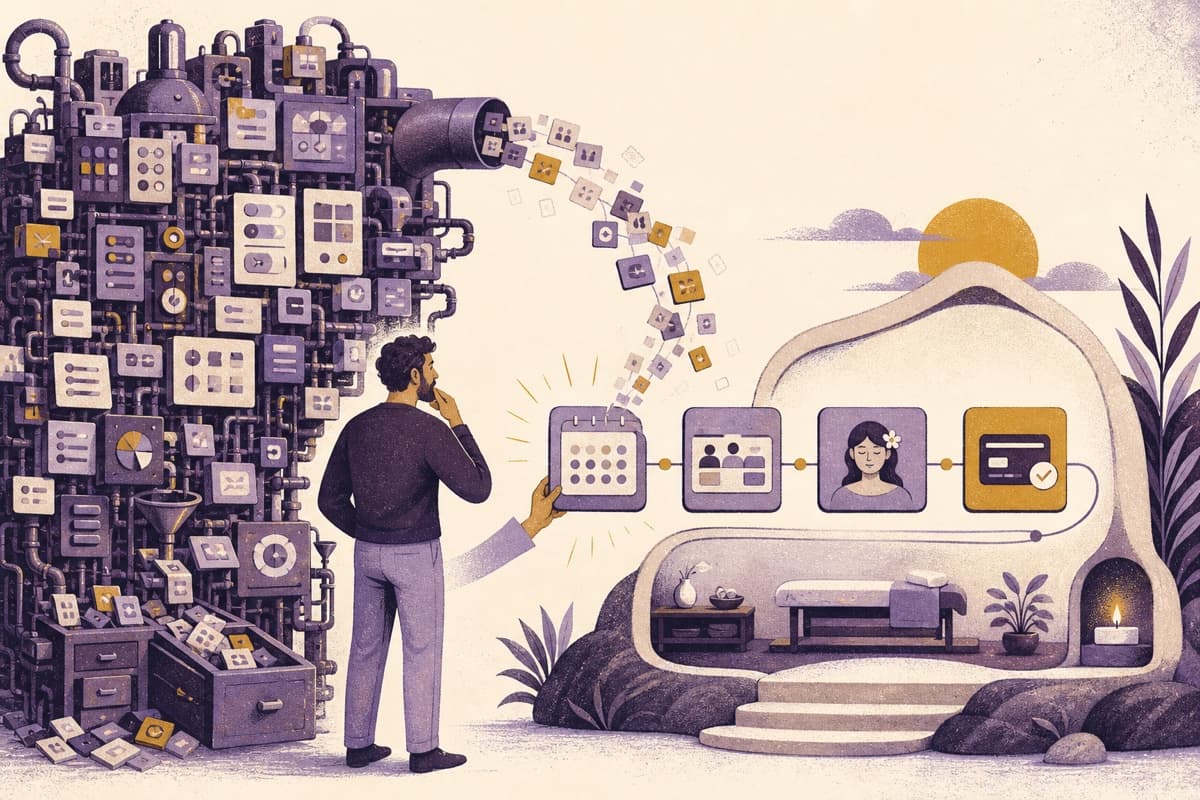
“We want a product like the market leader, but without its biggest gaps” can be a sensible starting point.
It becomes dangerous when “like” is interpreted as “copy every screen and feature.” Established SaaS products carry years of decisions made for other customers, pricing models, technical constraints, and internal teams. Recreating the visible surface also recreates complexity the new business may not need.
Smart360 began with a sharper brief. Rob, a spa owner in the United States, saw gaps in Vagaro that affected the way he wanted his business to operate. Trifaar's job was not to reproduce Vagaro. It was to understand those gaps and build a tailored product around Rob's workflow.
The competitor is evidence, not the specification
An incumbent product proves that a market and vocabulary exist. It also gives prospective users something concrete to react to.
Interview users about tasks, not feature names:
- What are you trying to complete?
- Where do you leave the current product for a spreadsheet or message?
- Which fields or steps feel irrelevant?
- What errors require staff intervention?
- Which reports do you rebuild manually?
- What would prevent you from switching?
The answers form a problem map. A screenshot inventory does not.
Separate familiarity from imitation
Users benefit from familiar patterns: a calendar should behave like a calendar, booking status should be visible, and common actions should be easy to locate. Familiarity reduces learning cost.
The new product still needs its own information architecture, visual identity, workflow, and domain model. Copying proprietary text, graphics, or distinctive expression can also create intellectual-property risk; legal review is appropriate when the line is unclear.
Build the differentiating workflow first
The first release should prove the market gap.
For a spa platform, the full universe might include scheduling, customers, staff, services, resources, payments, memberships, inventory, marketing, reporting, and mobile experiences. Trying to match every category delays the reason the product deserves to exist.
Start with the workflow the incumbent handles poorly. Connect only the supporting capabilities needed to complete it. Measure whether users experience the promised improvement before expanding.
Model the business states explicitly
Clone projects often look correct before they behave correctly.
A booking is not simply a row on a calendar. It may be requested, held, confirmed, rescheduled, completed, cancelled, marked as a no-show, refunded, or disputed. Staff, rooms, equipment, service duration, deposits, and time zones may affect availability.
Define those states and transitions before adding interface polish. The product should prevent invalid transitions and retain the history required for support and reconciliation.
Treat migration as part of the product
Customers do not arrive empty-handed. They bring contacts, appointments, service catalogues, staff schedules, balances, memberships, and historical records.
Plan import templates, field mapping, duplicate handling, validation, reconciliation, and a trial migration. Decide which history is necessary and which can remain in a read-only archive. Switching cost can defeat a better product if migration is treated as an afterthought.
Avoid inherited complexity
An incumbent may expose many controls because it serves multiple industries. Your product may win by removing decisions.
W3C's forms guidance captures the broader UX principle: users generally prefer short, simple forms, and unnecessary questions increase abandonment. Ask only for information required at that stage and make errors recoverable.
Make operational ownership visible
A production SaaS product needs permissions, audit history, backups, monitoring, support tools, billing reconciliation, and a release process. These features rarely appear in competitor screenshots, yet they decide whether the product can be operated.
For multi-tenant products, authorization must be enforced in backend and data access—not only in the navigation. Every integration should have a clear source of truth and retry strategy.
What went right with Smart360
Rob brought domain experience and a concrete view of the gaps. Trifaar translated that insight into product discovery, custom spa workflows, a management dashboard, and a working production platform. Smart360 was shaped as an operating system for Rob's business rather than a collection of copied features.
The result was a product Rob was happy to use and build his growing business around.
How Trifaar can help
Trifaar helps founders convert “a better version for this audience” into an original product strategy, validated workflow, UI/UX, backend architecture, integrations, DevOps, and production delivery.
We can begin with a competitor-gap workshop and a contained prototype. Our flexible credit model then lets the engagement shift between UI/UX, software engineering, senior architecture, and DevOps without retaining every discipline at the same level throughout the project.